The IIoT digital solution platform market- late 2018 round-up of my observations.

Do you know your platform solution?

Knowing your digital solutions is key to choose industrial platforms, as they might not meet your exact needs

What is under the hood of an Industrial Platform solution? What do you look for?

IIoT Platforms are still under significant construction

How do you judge the platforms that are out there?

Companies have this essential need to build an IoT platform today, or be at least very active partner in one, or even many, to fit their business goals. A platform connects, it connects your world with the rest of the world. Often when we talk about IIoT, it can get easily confused with IoT. Actually, IIoT, grew out of the other, IOT.

IoT is mostly about making the human interaction with the object(ives). IIoT is about connecting devices, sensors, building and improving manufacturing execution systems then applying intelligence and analytics to understand or improve the performance of the existing devices. The aim is to monitor, build parameters, sophisticated controls and search for solutions that will lessen the downtime and improve the productivity of the asset.

McKinsey estimates that the Industrial Internet of Things will create $7.5T in added-value by 2025. IIoT has been valued at around $255b as a market in 2025 (a past GE estimate). These two seem to offer very different estimates. In many ways, we are all confused and still guessing or predicting, because of so much uncertainty and not honestly knowing what comes next in technology invention that changes the position. We have learned, in our engagement and growing reliance just on the smartphone.

We have all learned to adapt and adopt so differently, as we connect more and more. In the IIoT world, there is predicted value across all of the connections (McKinsey view)  and as we see more solutions emerging, as ways to serve that “connected” need market growth will more than likely simply accelerate away. Speed, scale, scope are all accelerating away, and as companies, we need to find our positioning in this evolution and industrial internet. The 4th Industrial revolution is well-under way.

Let me provide a snapshot, my view, of where IIoT platforms-as-a-service sit today.

Read more

How Open Is Open? Check it out.

The broad use of ‘open’ does seem to have very different interpretations, especially when it comes to platforms or cloud-ready architecture.
Two examples for me in my research recently, needed some “airing” as the openness (excuse the pun) gives me a higher level of comfort. I wish others would state what openness really means in their offerings.

The two I have been drawn to are Aras and their open architecture platform for PLM and the other is Bosch with their IoT platform.

Let me take quotes from both to underpin that real clarity I believe the client would want before they go into a partnership. Today so much is banded about upon “lock-in” when you commit to platforms, it sort of scares of many potential clients wanting to have platform solutions, from making that investment. Trust and confidence in what you are actually signing up for, is needed to be fully transparent. Goes to say but is it?

In my view only having one platform provider is not the right path, it is a range of providers, selected because they can cater to your jobs and needs, not you having to fit into their architecture but it is this openness that significantly needs to be looked at closely.

Read more

Defining Ecosystems in Industry

Defining Ecosystems in Industry

In a recent exchange, actually, on twitter, we were discussing definitions of platforms for IoT or IIoT, defining ecosystems in industry. This was to shape a story to be told.

We got into the “how” to position them and in these exchanges, we eventually arrived at the question of Ecosystems, of “What defines ecosystems within an industry?”.

There is growing value in engaging in business ecosystems and let me offer the “why” and move you through the “what” towards the “how.” I felt it needed my “take” on defining Ecosystem design for Industry.

The present growing use of the word “ecosystem” has been born or borrowed (for industrial use) from ecology but it is not appreciating the understanding as well as it should do.

We in an industry do need to understand this, embrace it and interpret it in this ecological way, or design the Eco-friendly intent in a clear, game-changing way, that allows us to move forward at higher increased rates of change.

So the issue is what does make up an Ecosystem and make it stand apart and be valued for what it brings.

Read more

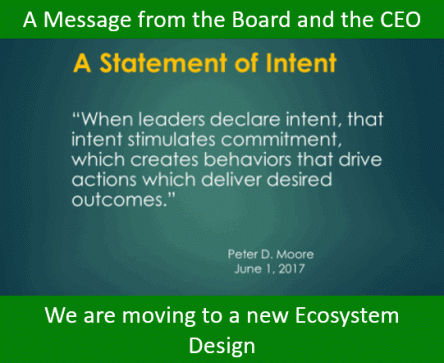
A Statement of Ecosystem Intent Inside Our Business Enterprise- the CEO letter currently missing

Ecosystems have become a really hot topic. As we gain the understanding of what a dual strategy approach to what our business could look like, you need to recognize what you still need control of, those you call your core assets. Yet at the same time, to explore and expand out more today we need to build better external collaborative approaches.
To achieve this reaching out and collaborating will require participating in platforms and building up your Ecosystem Management understanding.

The word “Ecosystem” is getting as much “air time” as the general use of the word “innovation” in business recently. It generates buzz, it projects the impression you are looking to the future, managing your business in that progressive, outward way, that shareholders and your employees love to here.

Well as we well only well know with innovation, if it does not align to strategy, integrate within the business activities, it stays a little out on one side. Also, innovation stays so often a necessity to “call upon” but not as your core focus of activity. That focus still is, sadly today focused on managing the assets for short-term performance, where the consistent focus is always on efficiency and effectiveness to “work or sweat those assets”. Maybe we might be seeing a change in ecosystem management design. More of the “assets” outsourced or in collaborative partnerships.

Well, Ecosystems are entering the lexicon of top management. It does sound good to talk about “building our ecosystem” in every possible way. You need to ask though, has management actually sat down and defined the type of ecosystem it wants to design, to participate in, or become part of. Or do this simply happen, a sort of drifting into, a grand experiment, as if that made real progressive sense? Let’s take a different approach

What if the CEO and the board decided to open up the discussion around the future pathway, one of managing within a federation of ecosystems.

Read more

Biting off more than we can chew can be a good thing……depending.

I had mentioned in a related post on my other posting site that I wanted to understand a recent Siemens event.

This was partly presenting 3rd financial quarter results but more on their future course with a Vision 2020+ and its respected parts being the design that is going to take the business out further by exploiting the parts within this vision.

There was a lot to take in on limited information and understanding. View the post “A feast of opportunities for Siemens?” for my first reactions on this.

The whole expansive story around Siemens new structure announced at this event offered some of the opening details, yet it is still to be “fleshed out” later in the year, by their management.

I specifically zoomed in on the new Digital Industries (DI) structure and where it is seemingly heading. Presently this new operating group will have 78,000 employees and a business revenue of around Euro 14 billion, that contributed a profit margin of around 16% in their fiscal 2017.

The expansion of the digitalization business has a very exciting acquisition announced the day before, with the Mendix acquisition, a leader, and pioneer in the area of low-code application development platforms, where you can potentially program and deploy apps up to ten times faster. This has been one of several “pain points” for Mindsphere, the Siemens digital platform, on providing a menu of apps to support client problems, so we should see some significant improvement on this point.

This purchase of Mendix can make a significant difference and propel the platform into a new value proposition, a 2nd generation digital platform where “smart” becomes central. I will be coming back to this once I have undertaken a little more research and assumption undertaking, in the next few days, as it has some compelling value positioning for Siemens, I believe.

It was the other part of the digitalization expansion that stopped me a little. This is what I want to discuss here. Let me work it through.

Read more

Opening up our thinking towards ecosystems has a powerful effect

ecosystems-abstract

Our whole understanding of innovation is changing, it is opening up to ecosystems and the necessary thinking and designing; there are numerous shifts occurring.

We are evaluating and changing our existing focus from closed (internal orientation) into ones that are having a far more open stance. We are searching for more collaborative innovation (external orientation) combining external partners into more ‘collective thinking’.

This shift is offering us extra acceleration that is needed to improve our innovation performances from concept to market delivery.

Collaborative innovation is also leading us to higher chances of achieving greater impact and success, as nearly all novel ideas lay outside the organization’s domain of understanding.

As we increasingly include the customer and their needs within our understanding, these multiple collaborations and dialogues are building this better internal understanding.

Read more

Platform Providers need to think more about Ecosystems Principles and Design

In my opening post (here) I was thinking where platform providers seem to be, in their current value proposition. I cannot see their approaches as sustaining. Now, this is a personal opinion and observation but let me lay out an alternative view.

I believe we are at an inflection point where the design of IIoT platforms needs to be integrated into a new way of Ecosystem Design.

There is a real need for a more shared value, breaking through the old traditional boundaries of single companies working with ‘selected’ providers of service and highly selective platform providers.

Ecosystem design is about being open in all potentially valuable proposals and co-creation possibilities. It is using multiple platforms as being part of a very different future design. You go where the best collaborations can take place not get .locked into one.

We need to stop and start to think about Ecosystems and their design for platform providers. Platforms have been amazing in their design, recognition, and value in a very short time.

Platforms are changing the way we undertake business. We have passed through the early phase of their design. It is now time to bring platforms into their place within a greater Ecosystem design.

Read more

The case for changing the IIoT platform providers value proposition

I have been reflecting recently on where we are in all the efforts, focus, and resources, that have been going into the building of our IIoT platforms. This has mainly been around the questioning of where they should fit within the needs of an ecosystem, the end outcome of our new industrial design, in my opinion, that enables digital transformation.

Let me offer up an initial case of why there is a need for a change in where we are on IIoT platforms and their current emphasis and focus on how we need to change the value equation out in the future in our solution designs and positioning of platforms, as a need to achieve. This is based on considering a greater ecosystem perspective, one that provides a sizable move towards a digital transformation we need to make.

Here I attempt to lay out the current position and suggest there is a case for change. The IIoT platform provider needs to change their value proposition urgently, in my opinion, or move along a faster evolutionary curve certainly, to get clients seeing their own value-add endgame, not just the IIoT providers race for dominating the platform space.

So let’s look at where IIoT platforms currently are, and in my related post where we might consider some changes in how we are evolving the platform story.

Read more

Have you got your digital twin strategy sorted out yet?

Gosh, where do you start on thinking through “digital twins”. The manufacturing industry is exploding with their digital twins to mimic their physical operations,

We have companies like Dassault who have been focusing on digital for many years taking a  specific focus on the human being and commercially releasing their “Living Heart”.

This “living heart” digital twin is the first realistic model of a human organ that actually accounts for electricity, mechanics and blood flow in the heart into a personalized full-dimensional model of the heart. Then users can practice and manipulate it, to place pacemakers, reverse chambers, cut out cross sections and run all sorts of hypothetical scenarios before the physical heart needs to be touched.

Then we have the digital twin that will learn all about you and what you do, think and work upon to provide you a closer replica of your daily life to help you. No, the digital twin is alongside us in multiple ways, it is not just a shadow in a mirror, mimicking all we do, in life and real time but it is working on finding better solutions to improve the actions being undertaken. It helps to predict, suggest and improve on our current activities.

Now stop and absorb that, please. The digital twin takes intelligence to a new level to mimic and then also predicts performance, based on the real-world performance you are feeding back into it.

Read more

Platform understanding is growing

I have put some focus back on the platforms recently, as this is becoming a real imperative to understand the whole meaning and implications of platforms, with the necessary management they require, so as to enable us to rethink different business models for the future.

There are without doubt real business implications in taking on a platform strategy as they really will be having such a transforming effect on all we do within companies and way beyond with others, including customers and even past competitors. They uproot the present and much of the established practicies.

They are changing the face of markets, industries, and competition but we within the established business world, mostly formed in the 20th centure seem slow to recognize their incredible impact, if we applied this platform thinking towards our own business, what would it mean?

There is a recognition that all innovation does not occur inside, it occurs from ‘open’ collaboration. It occurs from engagement and appreciating many others have better insights and possible answers, it is the power of combining them that has such economic consequence and great value creation potential. Our businesses are all becoming based on platforms.

The difficulty for many of us is first understanding what a platform is all about. The getting a clearer picture of the different types of platforms. Each has different tasks in building their specific “network effect” and how they are set up to interact and the type of problems they are attempting to solve. Some are really open, some are seeking growth, some are seeking collaborators to come together and work on ‘cracking’ more complex problems that one individual company would not be able to do.

In some of my recent updating of the platform breaking scene, I came across a terrific site that has created an open initiative to help entrepreneurs and organizations of all sizes to relate and build successful platform businesses, called Platform Hunt.

Read more